How to Read a Flexible Packaging Specification Sheet
The spec sheet arrives: three lines of letters and numbers, a paragraph about barrier properties, a row for the number of print colors. Most buyers glance at it, check it against the price, and sign. Most of the time nothing goes wrong—until the first batch starts leaking at the seals, or a second supplier quotes 30% less for what looks like the same bag. A spec sheet is not a routine attachment; it is a formula. If you can read it, you can tell whether you are paying for performance or for habit—and you can ask a question a supplier cannot paper over with a brochure.
1. The Spec Sheet Is Actually a "Sandwich Recipe"
It is written from the outside in, layer by layer. Each item is "material + thickness (microns)," separated by slashes.
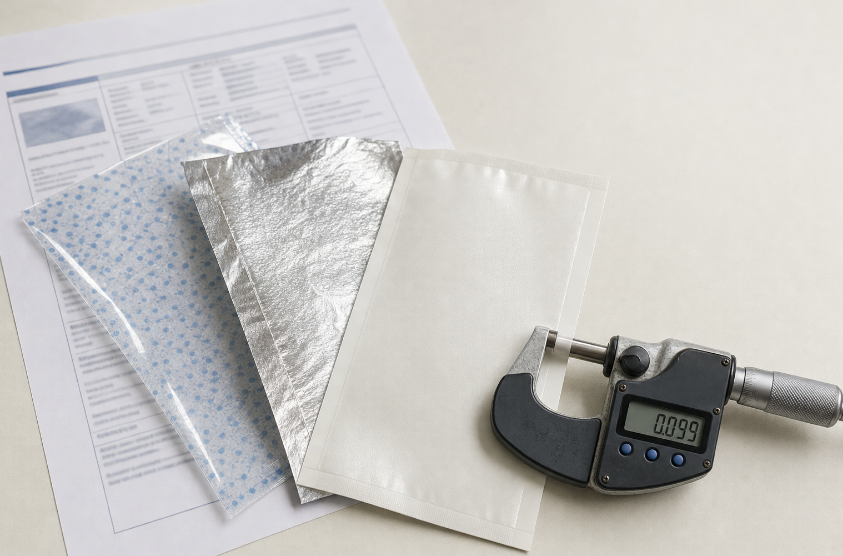
So PET12/AL7/PE80 means: an outer layer of 12-micron polyester, a middle layer of 7-micron aluminum foil, and an inner 80-micron polyethylene heat-seal layer—99 microns total.
That's it. The rest of the spec sheet—barrier data, seal strength, number of print colors—
Two things follow. First, order matters: the outermost layer is what the consumer touches and what gets printed; the innermost layer is what contacts the product and gets heat-sealed. Second, total thickness is not the point. Two films both 99 microns can perform completely differently, because performance comes from which layers are inside, not how thick the whole thing is.
2. What Each Layer Actually Does
In a well-designed film, every layer has a job. If you can't say what a layer does, it is probably just habit. The pattern is clear: no single film does everything well. PET prints beautifully but doesn't heat-seal; PE heat-seals well but lets oxygen through; aluminum foil blocks everything but develops pinholes and creases. A structure is how these weaknesses cancel each other out—which is why "swapping in a cheaper material for the same bag" is almost never the same bag.
By the same token, five layers are not necessarily better than three. Every extra layer means an extra lamination, an extra cost, and an extra failure point. Good converters are removing layers; average ones are adding them.
3. Microns, "Si," and Mil—One Film, Three Ways to Say It
This is where money most easily leaks away. Thickness becomes microns, "si," mil, or gauge depending on whom you are talking to, and the numbers look completely unrelated.
The conversions are simple: 1 "si" equals 10 microns, 1 mil equals 25.4 microns, and gauge is mil multiplied by 100. Domestic factories usually quote orally in "si," drawings and spec sheets use microns, and export quotes to European and American customers often switch to mil and gauge.
Why this matters: thickness is the number-one driver of per-unit material cost and the item most easily over-specified. If a product only needs an 8-"si" seal layer to withstand fill weight and drop testing, and you specify 10 "si," that SKU pays extra for its entire life cycle. The reverse is worse—skimping a few points on thickness and paying it back later in leak rates.
4. Printing: Gravure, Flexo, Digital
The printing method determines both appearance and cost structure, and what usually chooses it is not aesthetics but order volume.
Gravure requires an engraved cylinder for every color. Cylinders are expensive and slow to make but durable, and detail and gradient transitions are extremely fine. The money is upfront, so the larger the volume, the lower the unit cost.
Flexo uses photopolymer plates instead of engraved cylinders. Plates are cheap and fast, and it is more practical for short runs and simple graphics; quality has improved a great deal in recent years, but the finest gradients still favor gravure.
Digital printing needs no plates at all—no plate-making fee and no minimum order quantity created by plate-making—so short runs, test markets, and frequent design changes are basically its territory. The trade-off is unit cost at volume, and a narrower range of available substrates.
The real question is not "which is best" but "how many SKUs do I have, how often do I change artwork, and how big is each batch." Four flavors with a redesign every quarter is a digital question; one flavor, two million bags a year, is a gravure question.
6. The Last Four Lines of the Spec Sheet
They are printed at the bottom of the page, and every one of them has stopped a line at some factory.
Coefficient of friction. How slippery the film is against itself and against the machine. Too high and it won't pull, wanders off track, and misregisters; too low and the whole stack of bags slides off the pallet. It is reported as a range, and the range matters more than a single point.
Seal strength, and seal strength under contamination. Common units are grams per 25 millimeters, or newtons per 15 millimeters. But what really determines whether the line keeps running is whether the seal area still seals after a little powder, oil, or sauce gets into it. Ask for that test; don't just look at the "clean seal" number.
Corona treatment level. The unit is dynes. Surface energy determines whether ink and adhesive will hold, and it decays over time—especially on PE. If you discover poor adhesion months after printing, check the corona level and storage conditions first.
Wind direction and core. Which side of the film faces out, and whether the core is 3 inch or 6 inch. Get it wrong and at best the film runs backwards; at worst it won't fit on the machine at all—an extremely boring way to stop production.
8. Common Questions
Is thicker film stronger?
No. Puncture and tear resistance depend on the type and position of the layers, not total thickness. A 90-micron structure with a nylon layer will beat a 120-micron structure with no nylon in most drop and puncture tests.
Can I just copy a competitor's bag?
The look, yes. The structure is another matter: two bags that look identical may differ by three films and one lamination, with the difference showing up only in shelf life, leak rate, or how smoothly they run on the machine. Before copying, ask what problem each layer is solving.
Wrapping Cucumbers in Plastic Film Is Not the Villain, but It Is Not Innocent Either
Plastic packaging's triangle doesn't actually mean "recyclable"
Related Article